Fiend (1980)
“Certain legends have mentioned the Fiend, a hellish, destructive force capable of entering time-worn coffins and invading a decaying corpse, allowing the dead to walk the earth again.
The fiendish corpse maintains its youth and existence by withdrawing the life-giving energy from human victims, who suffer violent and painful death…”
So begins our preamble for what's about to occur in director Don Dohler's Fiend. I was taken aback at the realisation that this is my first coverage of Dohler’s cinema in these pages. I'm going to have to rectify this state of affairs, as his films have a lot to offer. Titles like The Alien Factor and Nightbeast – plus quite a few others – consistently offer low-budget charm and entertainment value. Stay tuned for more.
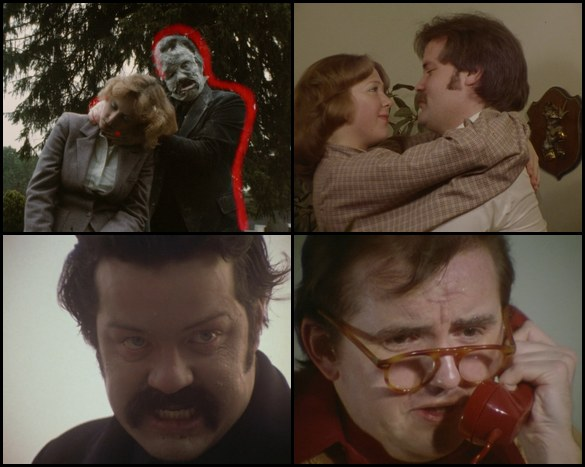
Back to Fiend, though. We see a graveyard in Seville, U.S.A. being invaded by a strange, half-human, floating red light. Drifting around and looking for something, it finally plunges into a grave. Soon, a woman in the cemetery is attacked by a ghoulish, decaying but very re-animated man. The creature glows with red light as it drains her life force away, and leaves her for dead.
Some time later, this zombie-vampire figure looks decidedly more human – though deathly white – and has set up shop as a music teacher in a nameless Spielberg-like suburb. Families potter and kids play in this human idyll, unsuspecting the horror that has infiltrated their cozy world. Now named "Eric Longfellow" (Don Leifert), the sinister figure lives in a suburban house with a dark and damp basement for a music teaching studio. Taking on an assistant, Dennis Frye (George Stover), Longfellow takes in his first violin students.
This status quo is soon to change for the macabre. "Longfellow" needs a constant supply of human life-force to survive, and look relatively human. That means going out and killing locals, most of them women. The tide begins to turn when he kills a young girl, and the townsfolk become more and more suspicious and concerned.
These include married couple Gary and Marsha Kender, who are very much in love – these two are all over each other and constantly kissing! – and Gary begins to suspect something amiss with Longfellow. Gary takes an instant dislike to the black-clad, chalk-white music teacher and as the bodies pile up around them, Gary investigates Longfellow's movements more intently. Marsha remains unconvinced however. Nonetheless, the net is closing in on the macabre "Fiend" when a boy witnesses Longfellow kill the simpering Frye, and reports the murder to Gary. Taking matters into his own hands, Gary may just be putting everyone around him in dire peril...
Clearly not a high-budget, polished production, Dohler achieves a lot of entertainment value and some sinister moments in Fiend. Don Leifert puts his moustachioed all into the role of Longfellow and appears to relish the moments when, wailing, he lashes out and stabs photos of his victims. It's strange that an evil spirit-possessed corpse wants to live a suburban life as a music teacher, drink wine and own a cat, but who am I to question it? Richard Nelson and Elaine White fare less well as the loved-up couple, but the also-moustachioed Nelson does passably enough as the Van Helsing to Longfellow's Dracula. George Stover is enjoyable as the insipid, sweaty Frye - is this a nod to Dwight Frye? - in a semi-comedic role.
I don't have any complaints about the cinematic quality of Fiend. Some of Dohler's edits are a little abrupt here and there, but the photography by Richard Geiwitz is appropriate for this type of film and has some nice off-kilter angles now and then. There's some nice effective close-ups of characters, that I always appreciate. The score by Paul Woznicki is enjoyable low-fi synthesizer mayhem and quiet piano plunking. Its constant presence and varying levels of hysteria are one of the film's highlights.
The makeup for the Fiend by Mark Supensky is actually pretty good. The close-ups when Longfellow starts hungering for life force, and begins to early-stage decompose are quite subtle but effective. Supensky uses latex to drag Leifert's eyelids down and places blisters on his ashen face. The fully decomposing Fiend is gruesomely good, well beyond the grey-face paint of some low-budget zombies.
Dohler's not afraid to take some bleak or unexpected narrative turns either. I won't spoil the ending, but I was a bit surprised at what went down in the last few minutes. Another tick in Fiend’s direction. To sum up, I'd definitely recommend this film to connoisseurs of drive-in and 'B' type cinema. It's a memorable, nifty little horror and that's all I could ask of it. Looking forward to adding more Don Dohler reviews in due course!
Do have a pleasant evening.
 Boris Lugosi© 2026 Girls, Guns and Ghouls